



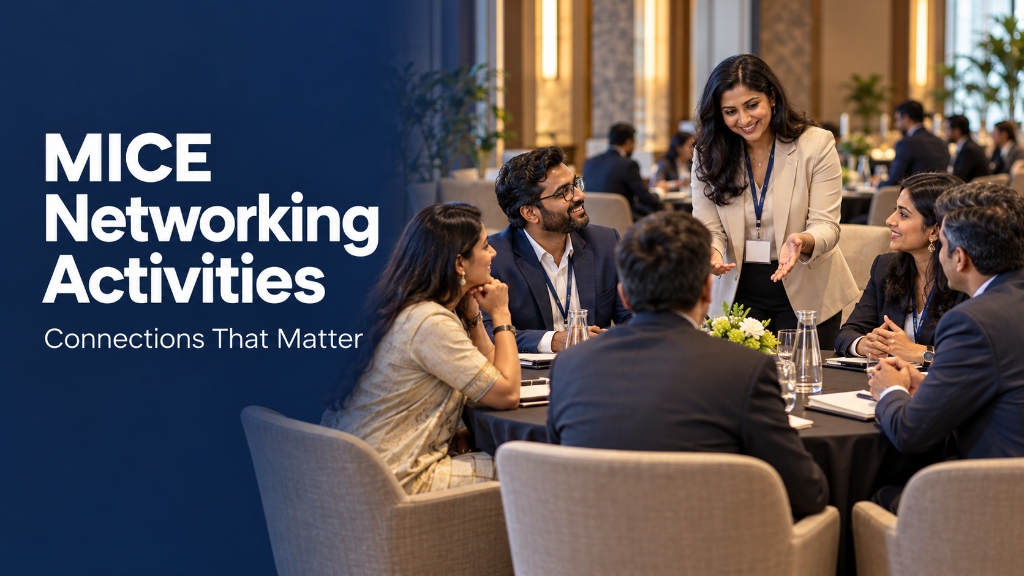
MICE networking activities work best when they're actually designed, not just scheduled as a gap between the agenda's real sessions. Too many corporate events treat networking as a coffee break with a fancier name, and the result is predictable: people gravitate toward the two or three colleagues they already know, quieter attendees hover near the edges of the room, and the whole thing wraps up with a stack of unused business cards.
That's a missed opportunity, especially given how much time and budget goes into MICE events in the first place. Networking is often the single biggest reason people attend a business event at all, yet it's frequently the least intentional part of the program.
In this blog, we'll look at why open mingling tends to fall flat, which formats genuinely create connections, and how to build networking into the structure of an event rather than around its edges.
hub The Core Principle
Networking must be engineered with intention, not treated as informal downtime between agenda sessions. Thoughtful structure removes awkwardness and ensures every attendee leaves with high-value business relationships.
Why Open Mingling Rarely Works at Corporate Events
Unstructured mingling sounds relaxed and democratic in theory, but in practice it favors people who are already comfortable approaching strangers. Everyone else either sticks with familiar faces or leaves early. There's no shared starting point for a conversation, no reason to cross the room to meet someone new, and no clear outcome by the time the session ends.
This matters more at corporate events than casual ones, because attendees are often there specifically to build relationships that lead somewhere — a partnership, a hire, a deal, or a useful contact for later. Leaving that to chance wastes the exact opportunity the event was built around.
MICE Networking Activities That Actually Create Connections
The events that generate real conversations tend to fall into a couple of clear categories, each solving the mingling problem in a different way.
Speed Networking
Timed, structured rotations ensuring attendees meet multiple peers one-on-one without the social barrier of cold introductions.
Targeted Roundtables
Discussions grouped by niche, industry sector, or shared operational challenges to give participants instant common ground.
Curated Matchmaking
Pre-arranged pairings based on participant objectives, synergy potential, or buyer-seller profiles at larger trade conferences.
Shared Experiences
Interactive workshops, local cultural immersion, or team culinary sessions that naturally eliminate small-talk tension.
Structured Formats
Speed networking remains one of the most reliable formats, rotating attendees through short, timed conversations so everyone meets several people regardless of how outgoing they are. Roundtable discussions grouped by industry or shared challenge work well too, since they give people an immediate sense of common ground before the conversation even starts. Structured matchmaking, where organizers decide who meets whom in advance based on interests or goals, takes this a step further and is especially effective at larger conferences and trade-style events.
Shared-Experience Formats
Icebreaker games and skill-share sessions, where attendees lead short talks on something they're genuinely good at, create a natural excuse to approach someone new. Activity-based networking, whether that's a sports session, a cooking workshop, or a cultural experience tied to the destination, tends to produce looser, more memorable conversations than a formal mixer ever does, largely because the activity itself removes the pressure of small talk.
What Makes a Corporate Networking Event Actually Add Value?
A few things separate networking activities that genuinely work from ones that just fill time. A clear purpose helps, whether that's connecting vendors with clients or building cross-team relationships, since attendees engage differently when they understand why they're there.
Table or group sizes matter more than people expect too; six to eight people tends to be the sweet spot, since smaller groups can go quiet and larger ones splinter into side conversations. A facilitator at each table keeps discussion moving, and giving attendees something concrete to walk away with — a contact, an idea, a follow-up action — turns a pleasant conversation into something worth remembering.
Key Elements of High-Value Networking Design
- check_circle Defined Intent: State the clear business goal upfront so attendees understand who they are meeting and why.
- check_circle Optimal Group Sizing: Stick to 6–8 participants per circle to prevent conversation monopolies or awkward silences.
- check_circle Active Facilitation: Appoint table leads or prompts to steer discussions toward actionable insights.
- check_circle Concrete Outcomes: Ensure delegates exchange contact details, shared notes, or clear next-step follow-ups.
Designing Business Event Networking Around the Agenda, Not Around the Gaps
The strongest events build networking directly into the main agenda instead of treating it as a competing activity squeezed in during breaks. That might mean a structured networking block right after a panel discussion, while ideas are still fresh, or an early breakfast session for executives who won't stay for an evening mixer but will happily show up at 7:30 AM for the right room of people. The goal is balance: enough structure that participation doesn't require social courage, but enough breathing room that the event doesn't feel over-programmed from start to finish.
lightbulb Strategic Timing Matters
Placing networking right after keynotes or high-impact presentations capitalizes on shared adrenaline and intellectual curiosity, making conversation flow effortlessly around topic themes.
How Do You Measure Whether Networking Activities Worked?
Attendance numbers don't tell you much on their own. A better measure is how many actual meetings or follow-ups happened as a result, since that's the outcome networking is meant to produce in the first place. Post-event feedback, even a quick two-question survey, can reveal whether people found the format useful or just tolerable.
Watching for repeat engagement, whether attendees stay in touch with the connections they made, is one of the clearest signs an event's networking design actually worked rather than just looked good on paper.
Bringing It Together: Logistics Behind Great MICE Networking
None of these formats run smoothly without solid logistics behind them, venue layouts that support small-group setups, reliable timing between sessions, and on-ground coordination that keeps the agenda on track.
This is where Aster Travel's end-to-end MICE and corporate event management makes a real difference, handling itineraries, venue logistics, and travel coordination so planners can focus their energy on designing networking experiences instead of managing the moving parts behind them.
Conclusion
Well-planned MICE networking activities don't happen by accident. They come from choosing formats that give people a reason to talk to someone new, sizing groups thoughtfully, and building networking into the agenda rather than around it. Corporate networking events built this way tend to produce the kind of connections attendees actually remember and follow up on.
The difference between a forgettable event and one people still mention months later usually isn't the venue or the catering. It's whether someone took the time to design the moments meant for connection, instead of just hoping they'd happen on their own.
Written by Shaji
Corporate Travel & MICE Specialist
Expert in corporate travel management, group MICE logistics, and VIP hospitality services for international delegations at Aster Travel.
Planning a MICE Event or Corporate Offsite?
Aster Travel coordinates venue selection, seating arrangements, group transport, and on-ground execution — ensuring your corporate networking runs flawlessly.